

Rated 4.7 out of 5 stars
4.7 / 5


726,000+ customers
Free 60-Day Returns
1-Year Warranty
726,000+ customers
Free 60-Day Returns
1-Year Warranty
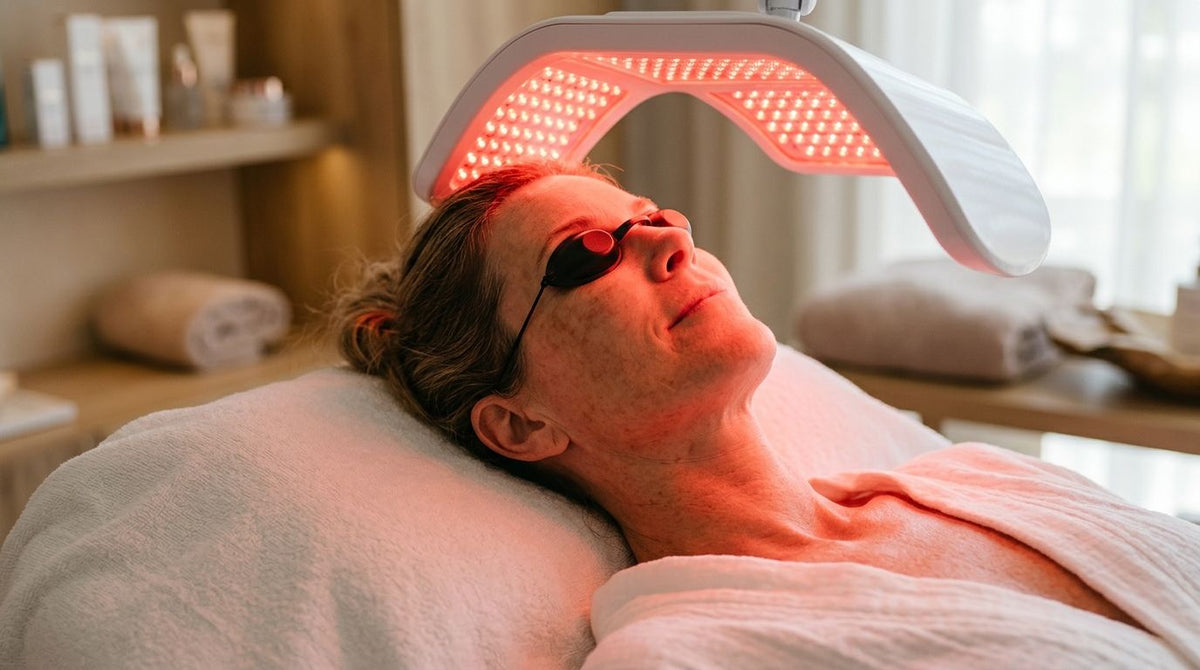
Red light therapy for sun-damaged skin targets the collagen breakdown, dark spots, and rough texture that years of UV exposure leave behind — not just the fine lines that show up on a general anti-aging routine. If you're dealing with sunspots, crepey texture, or a dull, uneven tone from decades of unprotected exposure, the approach differs from standard at-home LED use in frequency, wavelength focus, and how long you wait before judging results.
UV exposure breaks down collagen and elastin in the dermis and triggers excess melanin production at the surface — two separate problems that show up as thinning, crepey skin and stubborn dark patches at the same time. A general anti-aging routine built around fine lines alone won't touch the pigmentation half of that equation, and a pigmentation-only routine ignores the structural damage underneath.
Red light therapy addresses both because red wavelengths stimulate fibroblast activity for collagen, while consistent, longer-duration sessions over pigmented areas help even out tone. Solawave's 4-in-1 Radiant Renewal wand pairs red light with warming and microcurrent modes specifically for this kind of layered damage — one device, two problems, but only if you use it correctly for sun damage rather than general maintenance.
Not all photodamage looks the same, and your starting pattern determines where you spend the most device time.
Sporadic use is the single biggest reason people give up on red light therapy for sun damage before it works. Sun damage accumulated over years and it doesn't reverse in a handful of sessions.
General full-face passes won't move stubborn pigmentation as fast as focused attention. Spend deliberate extra time over discolored patches instead of treating the whole face uniformly.
The structural side of sun damage — crepiness, sagging texture, deeper static lines — responds to full-coverage sessions rather than spot treatment alone. This is where a mask outperforms a targeted wand pass.
What you put on skin before and after a session changes how much benefit you get from it. Heavy, occlusive products before treatment reduce how well light penetrates.


| Option | Best for | Key limitation |
|---|---|---|
| At-home red/NIR light (wand or mask) | Ongoing maintenance, collagen support, mild-to-moderate pigmentation | Slower visible change than in-office procedures |
| In-office IPL or laser | Deep, defined pigmentation and broken capillaries | Requires repeat visits and some downtime |
| Chemical peels | Surface texture and dullness | Doesn't rebuild collagen; needs professional repeats |
| Topical retinoids/vitamin C alone | Prevention and mild tone support | Slow on its own without a light-based add-on |
Anyone who's looked into pigmentation treatment costs at a dermatology clinic understands why at-home red light therapy has become the default maintenance layer between procedures — it doesn't replace an IPL session on deep, defined spots, but it extends and protects the results once you've had one, at a fraction of the recurring cost of repeat professional visits.
Does red light therapy actually work on sun-damaged skin?
Red light therapy supports collagen production and can even out tone from sun-induced pigmentation with consistent use, typically several sessions weekly over multiple weeks. It works best alongside daily SPF rather than as a standalone fix for existing damage.
How long until I see results on sunspots?
Tone changes from consistent red light sessions take longer to show than fine-line improvement, often requiring weeks of steady use rather than days. Photograph the same spots monthly under matching light to track real change.
Is red light therapy better than IPL for sun damage?
IPL works faster on deep, well-defined pigmentation but requires professional visits and some downtime. At-home red light therapy is the slower, ongoing option that also supports collagen in thinning skin between or after in-office treatments.
Can I use red light therapy on sun-damaged hands or chest, not just the face?
Yes — décolletage and hand skin show sun damage the same way facial skin does, and dedicated masks like the Neck & Chest Pro exist specifically for that area. Wand-based devices also work on hands with direct, consistent contact.
Should I stop using retinol if I add red light therapy?
You don't need to stop retinol, but avoid using a strong retinol the same night as an intensive light session on already sun-damaged, barrier-compromised skin. Space them on alternating nights instead.
Do I still need sunscreen if I'm treating sun damage with light therapy?
Yes, daily broad-spectrum sunscreen is non-negotiable. Red light therapy repairs existing damage; it does nothing to block new UV exposure from adding more.
How often should I use red light therapy for sun damage in 2026?
Start at 3-5 sessions per week and hold that pace for several consistent weeks before increasing. Daily use is reasonable once skin tolerates the initial schedule without irritation.
The pigmentation half of sun damage almost always improves slower than the texture half — most people notice smoother, firmer skin before their dark spots visibly lighten, and quitting during that gap is the most common reason at-home red light therapy for sun-damaged skin gets written off as "not working" when it just needed more weeks.
 Acne
Acne


